Physical Address
304 North Cardinal St.
Dorchester Center, MA 02124
Physical Address
304 North Cardinal St.
Dorchester Center, MA 02124

What is an AI agent? Learn how goal-driven AI systems use reasoning, memory, and tools to automate workflows and deliver measurable business ROI.
Artificial intelligence is everywhere. Chatbots answer questions. Tools generate content. Automation platforms trigger workflows.
But an AI agent is something different.
It’s not just a model.
It’s not just a chatbot.
It’s not just automation.
An AI agent is a system that can observe, reason, decide, and act autonomously toward a goal.
In this article, we’ll break that down clearly
Most companies think:
If it talks like ChatGPT, it’s an AI agent.
That’s incorrect.
There’s a major difference between:
Understanding that difference is critical before investing in AI.
An AI agent is:
A goal-driven system that uses reasoning, memory, and tools to autonomously take actions in an environment.
Let’s break that down.
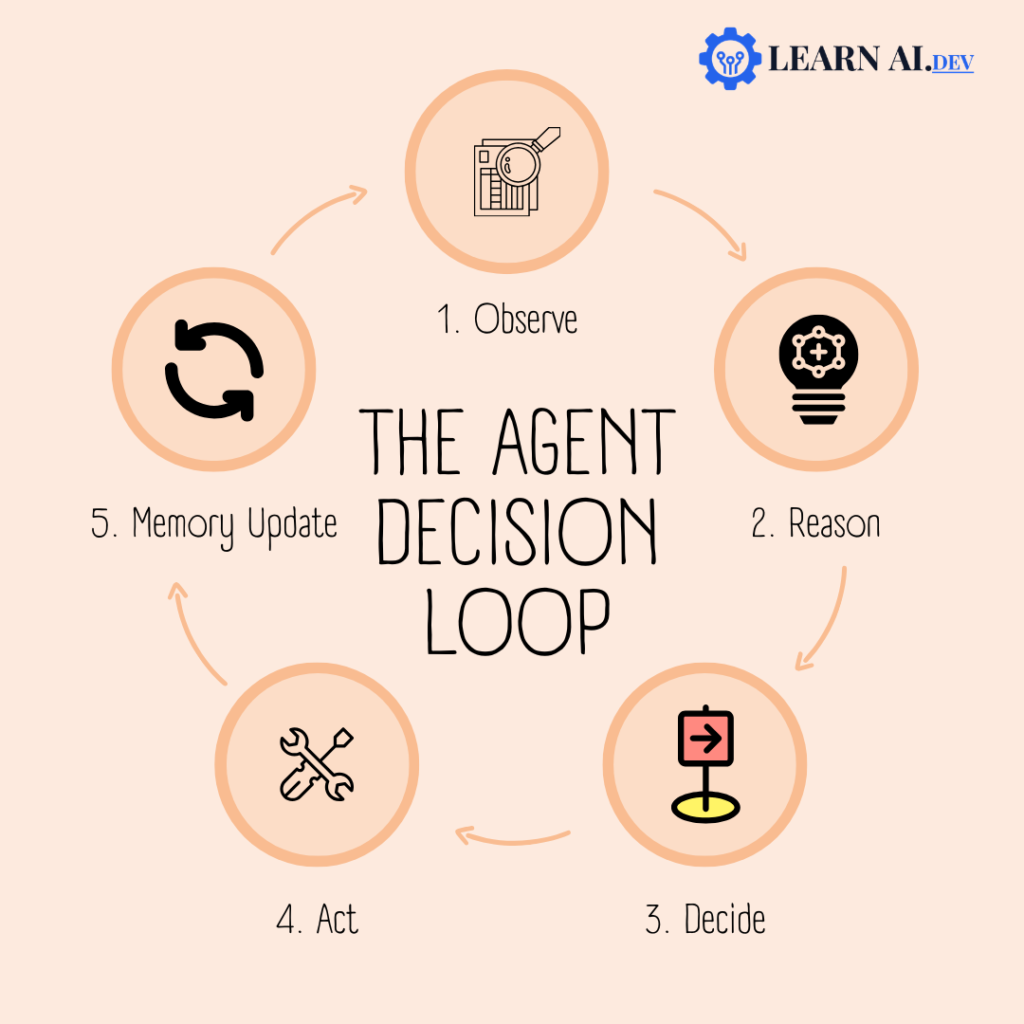
An AI agent must have:
Without these components, it is not truly an agent.
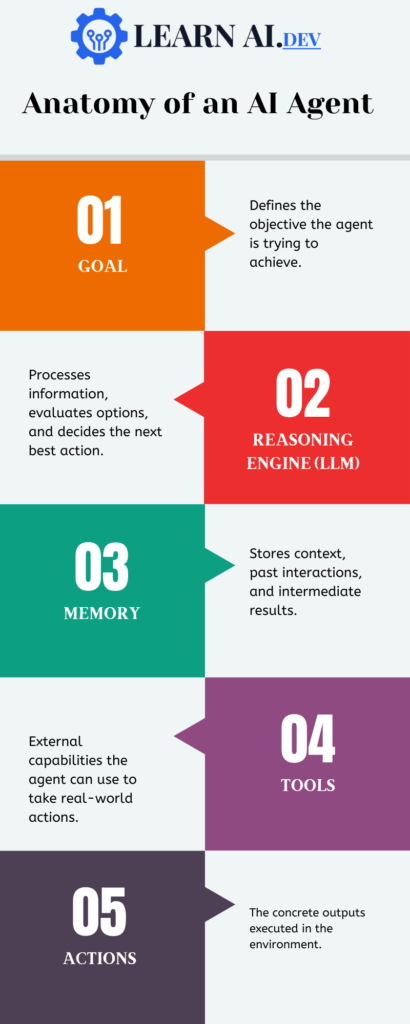
At its core, every AI agent follows a loop:
Observe → Reason → Decide → Act → Learn → Repeat
Let’s explain each.
The agent gathers input from users, APIs, databases, or systems.
The LLM processes context, evaluates options, and generates potential actions.
The system selects the next best action aligned with the goal.
The agent executes through tools (API calls, database updates, emails, etc.).
Memory updates. Context expands. The system improves.
| Feature | Chatbot | AI Agent |
|---|---|---|
| Responds to prompts | Yes | Yes |
| Has goal persistence | No | Yes |
| Uses tools | Limited | Yes |
| Executes multi-step plans | Rarely | Yes |
| Maintains memory | Minimal | Structured |
| Acts autonomously | No | Yes |
A chatbot reacts. An agent pursues objectives.
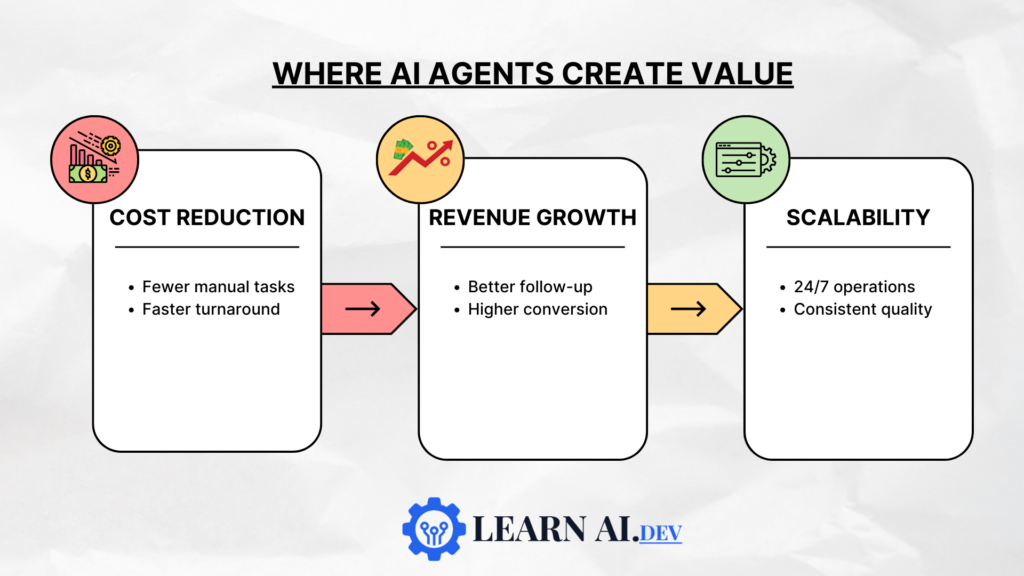
Let’s move from theory to ROI.
Goal: Resolve tickets under 5 minutes.
An agent can:
Not just answer; resolve.
Goal: Increase response rate.
An agent can:
Goal: Reduce manual approvals.
An agent can:
This builds credibility.
Avoid agents if:
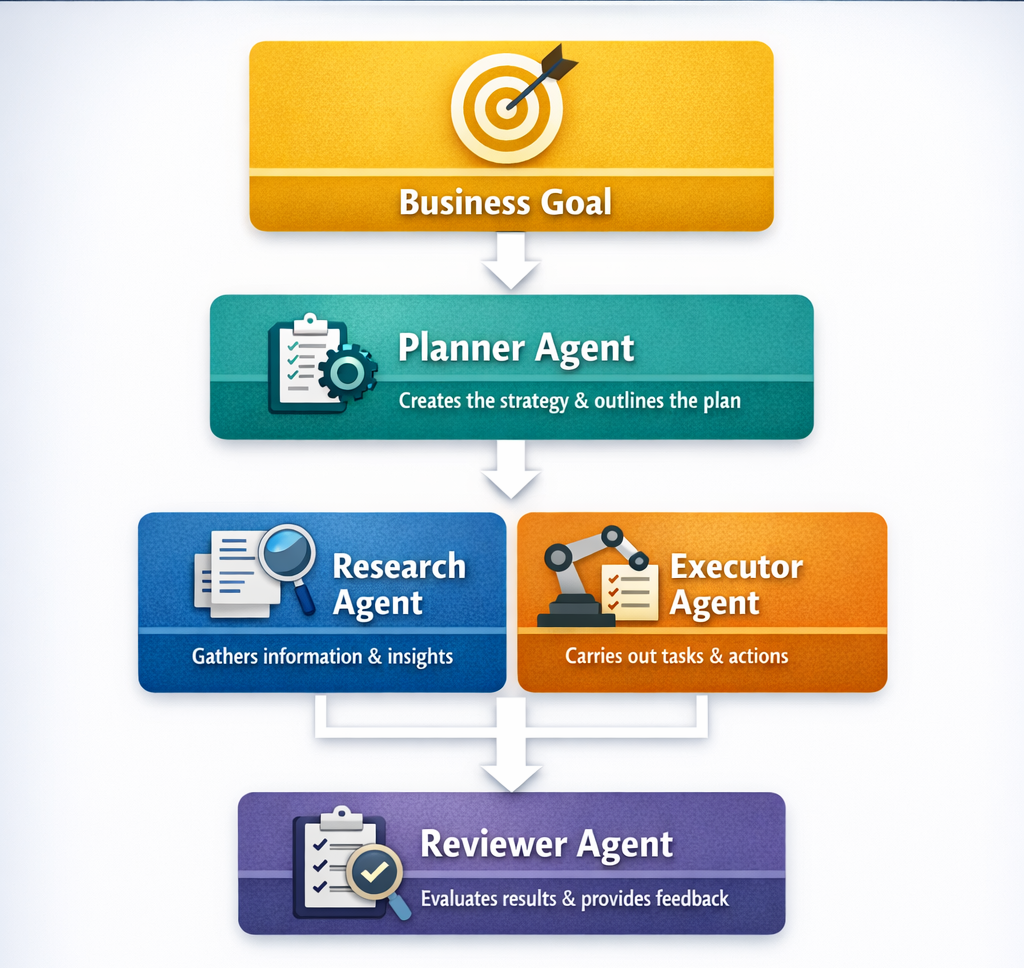
Single agents handle simple tasks.
Multi-agent systems coordinate:
Together, they simulate departmental collaboration.
This is where serious ROI begins.
AI agents are not magic.
They are systems.
Systems require:
When built correctly, AI agents shift from novelty to infrastructure.
And infrastructure drives ROI.
An AI agent is not a chatbot.
It is a goal-oriented autonomous system built around reasoning, memory, and action.
Businesses that understand this distinction will build systems.
Businesses that don’t will chase tools.
Subscribe to get the latest posts sent to your email.



[…] the previous article, we defined an AI agent as a goal-driven system that can reason, use tools, and take […]