Physical Address
304 North Cardinal St.
Dorchester Center, MA 02124
Physical Address
304 North Cardinal St.
Dorchester Center, MA 02124
Learn why RAG chatbots are not enough for business workflows and how AI agents enable automation, decision making, and real operational value.
Most companies exploring AI follow a similar path. They start with a chatbot.
Then they add retrieval. Soon they describe the system as “AI-powered.”
But in many cases, what they have built is still a reactive interface.
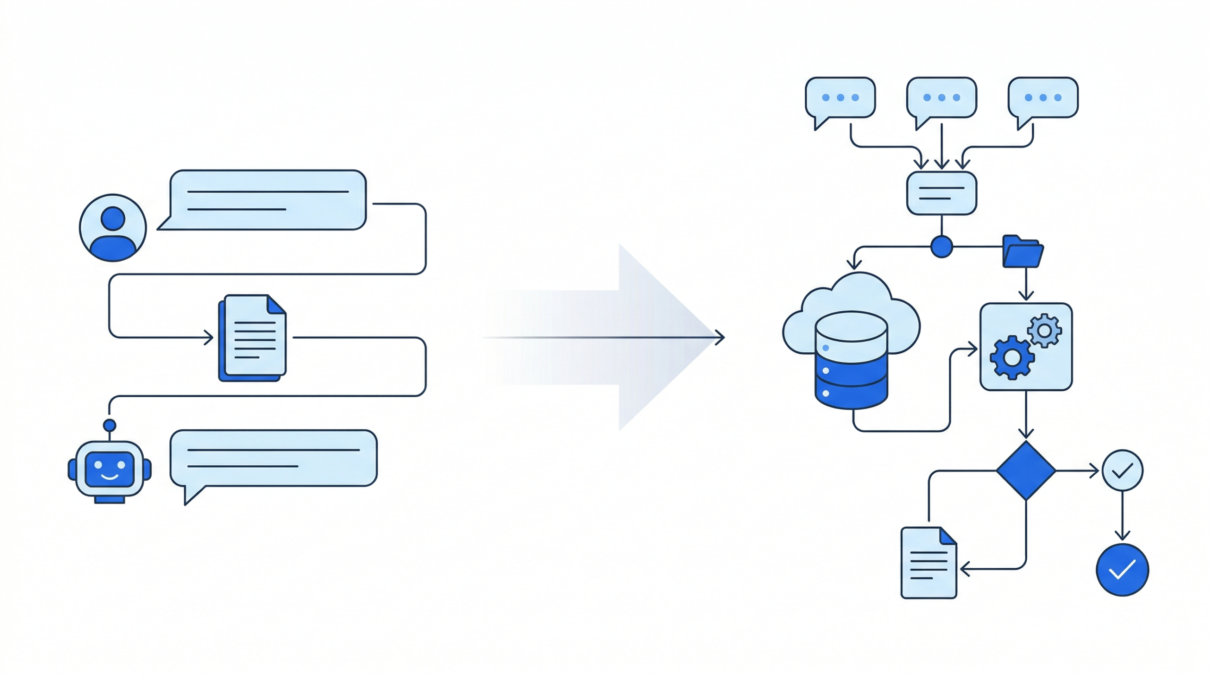
It can answer questions. It cannot run processes. That distinction matters.
If the goal is to generate responses, chatbots and RAG systems are often enough.
If the goal is to automate work, something more structured is required.
That is where AI agents come in.
Large language models made it easy to build conversational interfaces.
With a prompt, an LLM can generate text, summarize content, or answer questions.
RAG, or Retrieval Augmented Generation, improves this further by connecting the model to external data.
Instead of relying only on training data, the system retrieves relevant documents and uses them to generate more accurate responses.
This is useful.
It improves factual accuracy.
It makes systems more context-aware.
It reduces hallucinations in knowledge-based tasks.
For many use cases, this is enough.
But it is important to understand what RAG actually does.
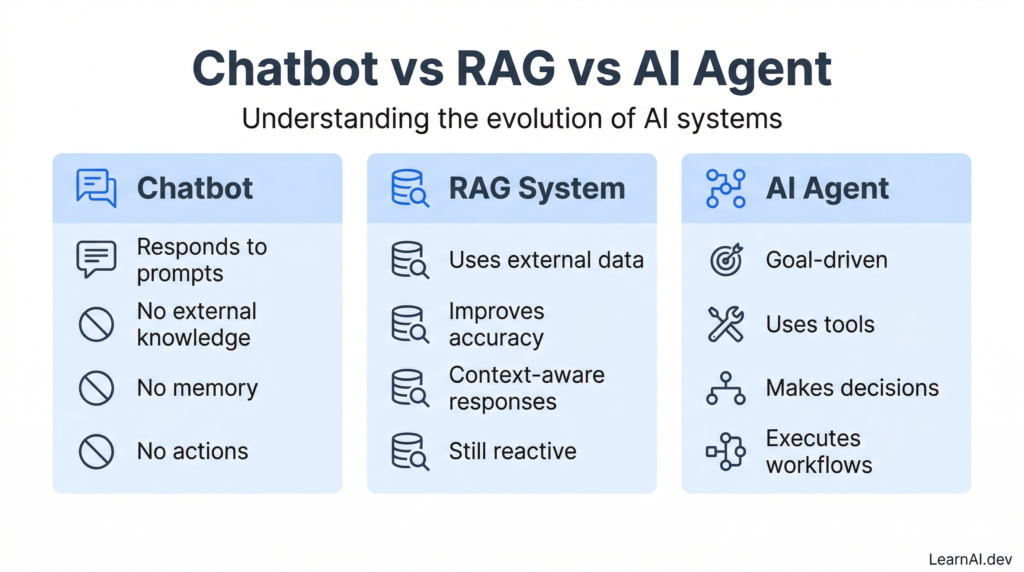
RAG solves a specific problem. It helps systems answer questions using the right information. That is valuable for:
Knowledge base search
Documentation assistants
Customer support queries
Internal information retrieval
However, RAG systems remain reactive.
They wait for a prompt. They retrieve information. They generate a response.
They do not:
Take actions
Execute workflows
Make decisions across multiple steps
Coordinate tasks over time
RAG improves answers. It does not create systems that operate.
Businesses are not built on answers alone. They are built on processes.
Consider a simple workflow :
A customer submits a support request. A human agent reads the request, searches documentation, drafts a response, checks for accuracy, and updates internal systems.
A RAG chatbot can assist with parts of this. It can answer questions. It can suggest responses.
But it does not complete the workflow.
It does not:
Track the state of the request
Decide next actions
Update systems
Ensure resolution
This is the gap between assistance and automation.
AI agents introduce structure. They are designed around goals rather than prompts. An agent does not just respond. It observes, reasons, decides, and acts. This allows the system to move beyond answering questions and begin executing tasks.
Key capabilities of AI agents include:
Goal orientation
The system works toward a defined outcome.
Decision making
It evaluates options and selects actions.
Tool usage
It interacts with APIs, databases, and external systems.
Multi-step execution
It completes workflows across several stages.
Instead of generating a single response, an agent manages a process.
The difference between RAG systems and AI agents can be summarized simply.
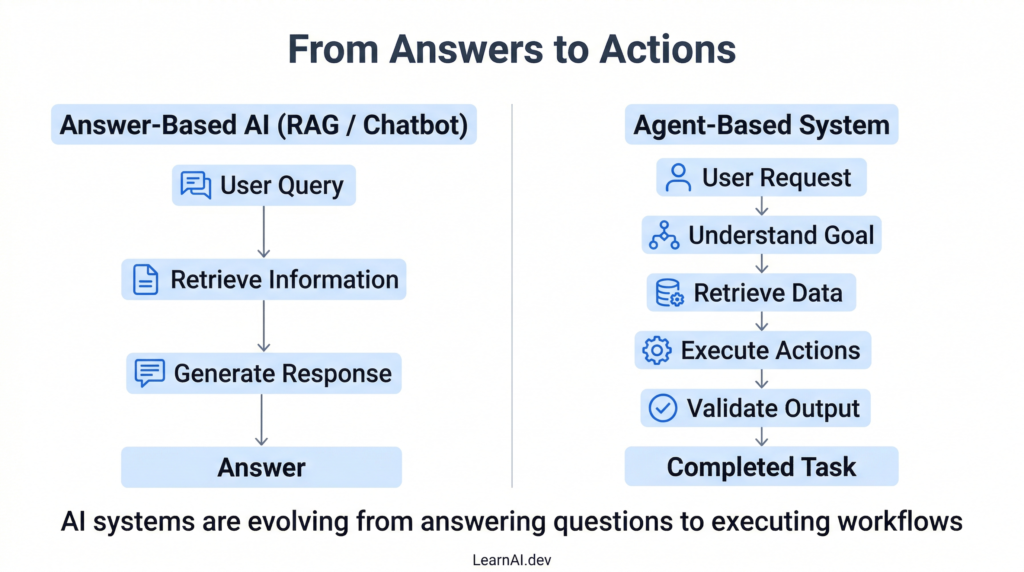
RAG systems answer. AI agents act.
Consider the same customer support example.
A RAG system:
Retrieves relevant documentation
Suggests a response
An AI agent system:
Analyzes the request
Retrieves relevant information
Drafts a response
Validates accuracy
Updates the support ticket
Marks the issue as resolved or escalates if needed
This shift from answering to acting is what enables real automation.
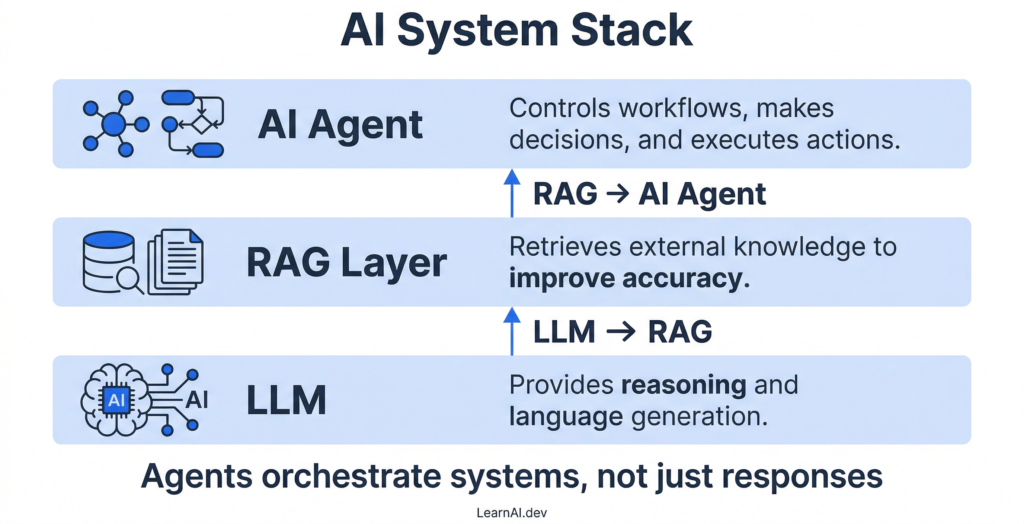
It helps to think of these components as part of a larger system.
An LLM provides reasoning capability. RAG provides access to external knowledge. An AI agent provides structure, coordination, and execution.
Together:
LLM is the intelligence
RAG is the knowledge layer
An agent is the system that operates
This layered view clarifies how these technologies fit together.
RAG systems are effective in many scenarios.
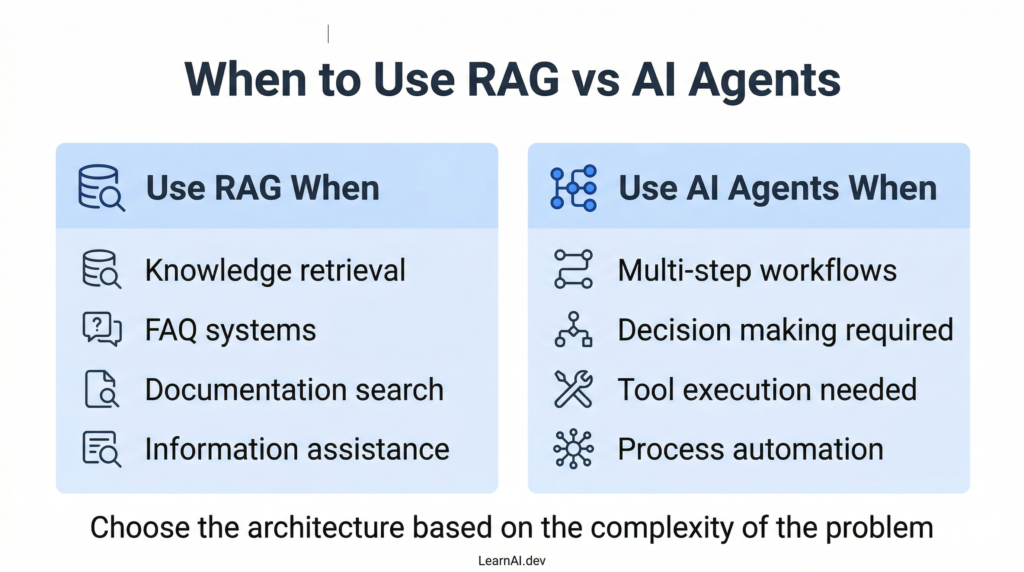
Use RAG when the primary goal is:
Answering questions
Retrieving knowledge
Providing contextual information
Supporting human decision making
Examples include:
Internal knowledge assistants
Customer FAQ systems
Documentation search tools
In these cases, adding full agent architecture may not be necessary.
AI agents become valuable when workflows are involved.
Use agents when:
Tasks require multiple steps
Decisions must be made during execution
Systems need to interact with external tools
Outputs must trigger further actions
Examples include:
Customer support automation
Sales lead qualification
Report generation workflows
Operational monitoring systems
In these cases, structure is more important than simple response generation.
Many organizations assume that adding RAG to a chatbot is equivalent to building an AI system. This leads to a gap between expectations and outcomes. The system answers well, but does not reduce workload. The system provides information but does not complete tasks. To achieve measurable impact, businesses need to move from conversational interfaces to process-driven systems. That requires agents.
AI adoption is moving through stages. First, tools that assist with tasks. Then, systems that generate responses. Now, systems that execute workflows. This shift is not about replacing chatbots. It is about extending them into structured systems that can operate reliably. The focus moves from interaction to execution.
Chatbots and RAG systems are valuable. They improve access to information and enhance user experience. But they are only part of the solution.
Businesses do not run on answers. They run on processes.
AI agents bring structure, coordination, and execution to those processes. That is what transforms AI from a helpful interface into an operational system. Understanding this distinction is the first step toward building systems that deliver real business value.
Subscribe to get the latest posts sent to your email.