Physical Address
304 North Cardinal St.
Dorchester Center, MA 02124
Physical Address
304 North Cardinal St.
Dorchester Center, MA 02124
Learn how to measure the ROI of AI agents with a practical framework that calculates automation value, cost savings, and productivity gains.
Artificial intelligence agents are moving from experimentation to real business workflows.
Organizations are using AI agents to automate research, analyze data, generate reports, qualify leads, and manage operational tasks.
But one question keeps coming up in executive conversations.
What is the actual return on investment?
Many companies deploy AI tools without a clear framework for measuring value. They experiment with automation but struggle to connect it to measurable outcomes.
To move from experimentation to adoption, businesses need a structured way to evaluate the economic impact of AI systems.
This is where an AI Agent ROI framework becomes useful.
Traditional software investments are relatively easy to evaluate.
A system replaces a manual task. Costs decrease. Productivity increases.
AI systems are different.
They introduce new capabilities, such as reasoning, decision-making, and autonomous task execution. The value they create is often distributed across multiple stages of a workflow.
This makes the impact harder to measure.
Common challenges include:
Unclear baselines for manual effort
Difficulty estimating productivity improvements
Indirect value from faster decision-making
Operational improvements that are hard to quantify
Without a clear measurement framework, AI initiatives risk becoming experiments rather than strategic assets.
Return on investment measures the value generated compared to the cost of deploying and maintaining the system.
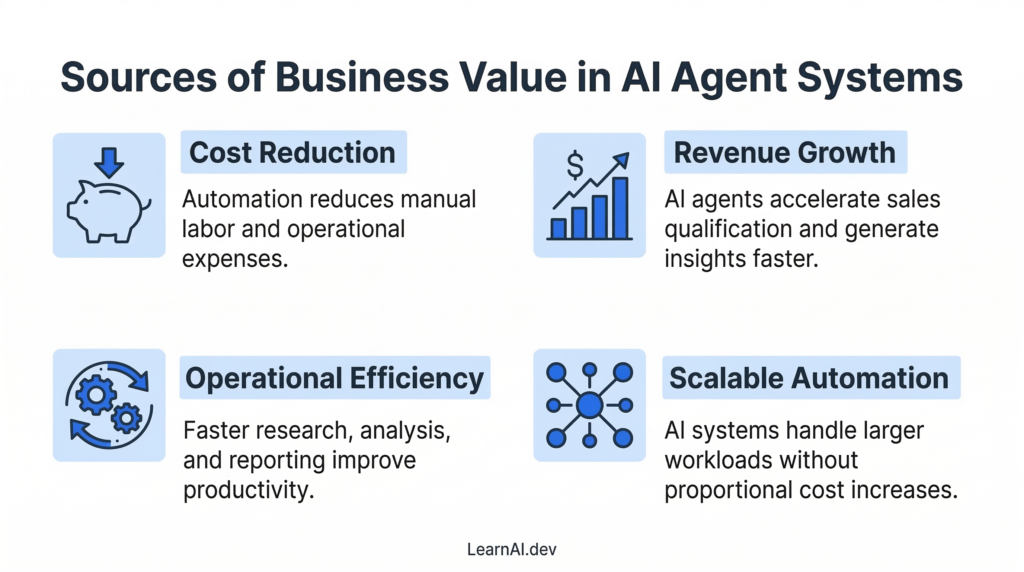
In the context of AI agents, ROI usually comes from four primary sources.
Cost reduction
Revenue growth
Operational efficiency
Scalable Automation
Each of these contributes to the overall value created by autonomous systems.
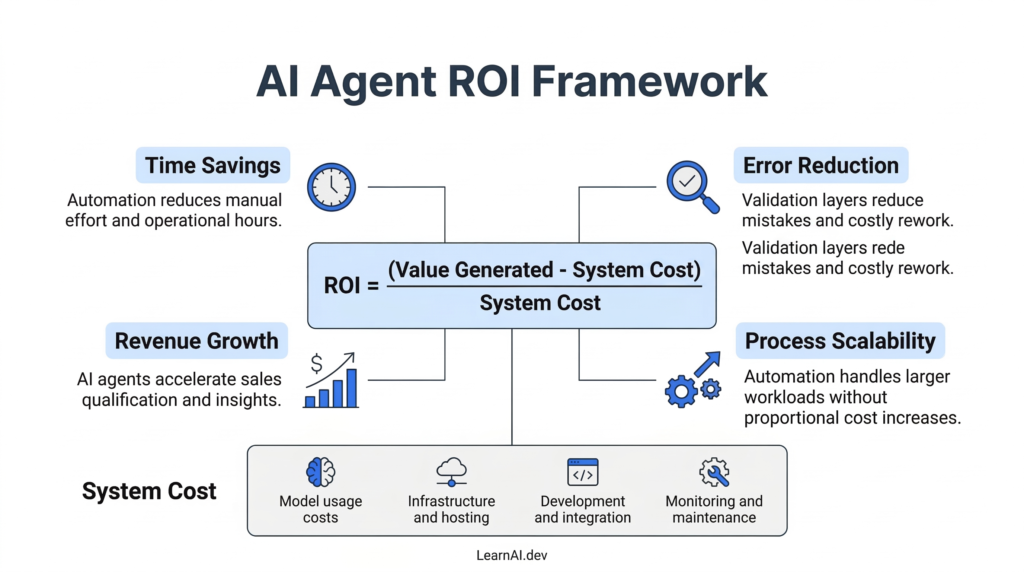
A simple ROI model can be expressed as:
ROI = (Value Generated − System Cost) / System Cost
To apply this formula in practice, we need to understand the components that create value.
In AI agent systems, value typically appears in four areas.
Time savings
Error reduction
Revenue acceleration
Process scalability
Together, these factors define the business impact of AI automation.
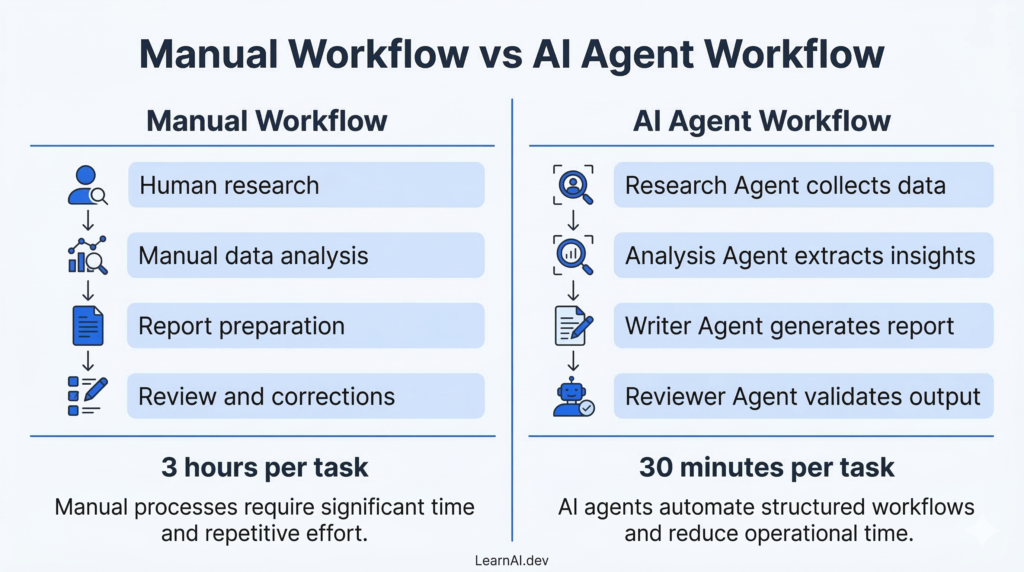
One of the most immediate benefits of AI agents is reduced manual effort.
Consider a customer support workflow.
A support team might handle hundreds of tickets per day. Each ticket requires reading the request, searching for information, drafting a response, and verifying accuracy.
An AI agent can assist with several of these steps.
It can analyze incoming requests, search knowledge bases, draft responses, and suggest relevant documentation.
Even partial automation can significantly reduce handling time.
For example:
Average manual handling time per ticket: five minutes
Tickets processed daily: two hundred
Total daily time spent: one thousand minutes
If an AI agent reduces average handling time by 50%, the organization saves 500 minutes per day.
Over a month, this amounts to more than 200 hours of reclaimed operational time.
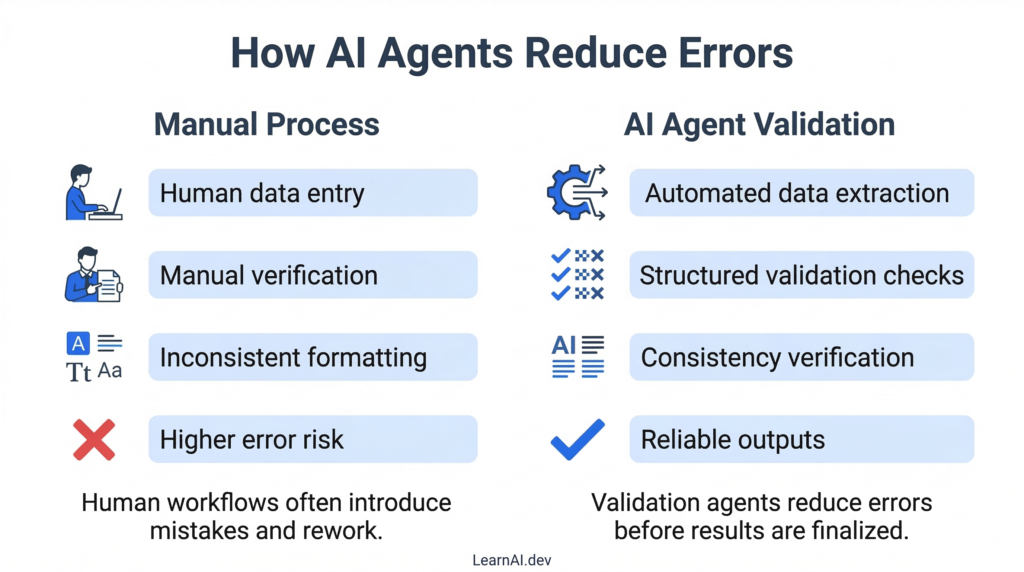
AI agents can also improve accuracy through structured validation layers.
Many workflows suffer from human error. Data entry mistakes, inconsistent formatting, and overlooked details create rework and operational risk.
AI systems can introduce validation checkpoints.
For example:
Reviewer agents can check generated outputs against defined rules.
Data extraction agents can verify numerical consistency.
Compliance agents can flag potential policy violations.
Reducing errors lowers rework costs and increases operational reliability.
In regulated industries such as finance or healthcare, improved accuracy can also reduce compliance risk.
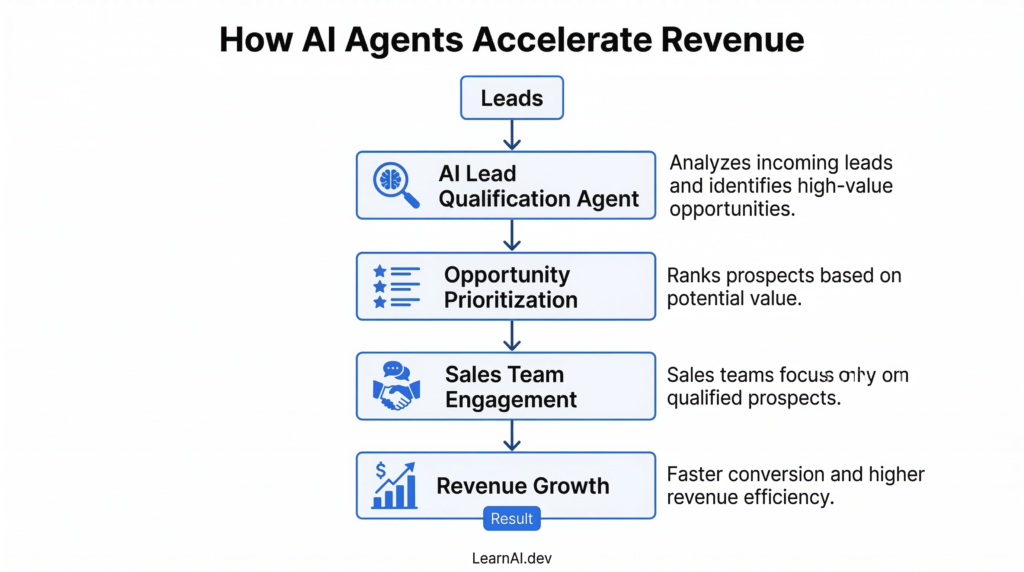
AI agents not only reduce costs. They can also improve revenue-generating activities.
Consider a sales qualification workflow.
Sales teams often spend significant time reviewing inbound leads to determine whether they are worth pursuing.
An AI agent can analyze lead information, enrich company data, and evaluate whether the lead fits the target customer profile.
This allows sales teams to focus on higher-quality opportunities.
The result is faster response times and higher conversion rates.
In this scenario, the value of AI is not just time saved. It is an increased revenue potential.
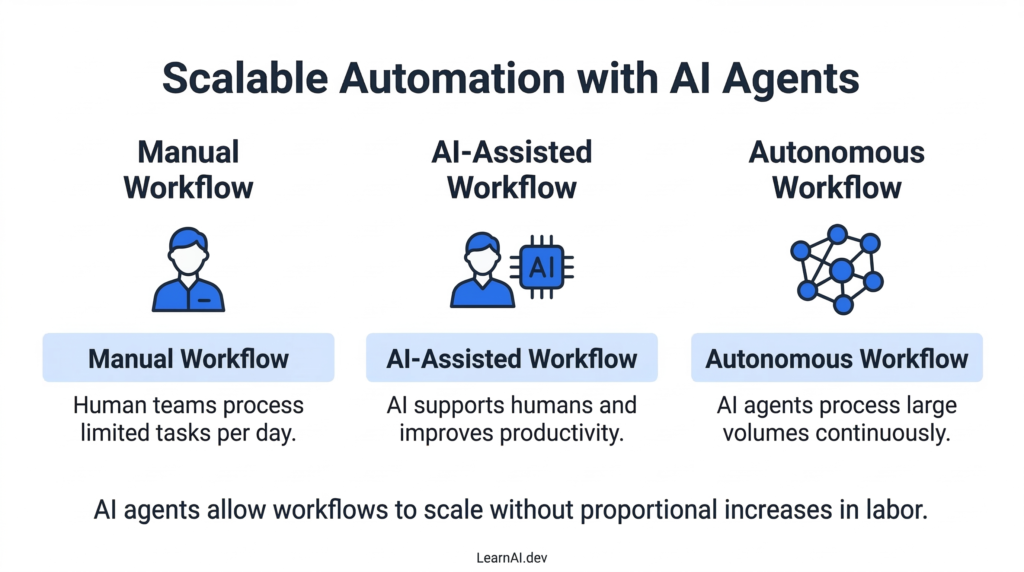
Human workflows are constrained by capacity.
As demand increases, organizations must hire additional staff or accept slower response times.
AI agents introduce scalable automation.
Once a workflow is automated, it can handle increased volume with minimal additional cost.
For example:
An automated research agent can continuously monitor hundreds of sources.
A reporting agent can generate daily summaries without additional labor.
This scalability allows businesses to expand operations without proportional increases in operational cost.
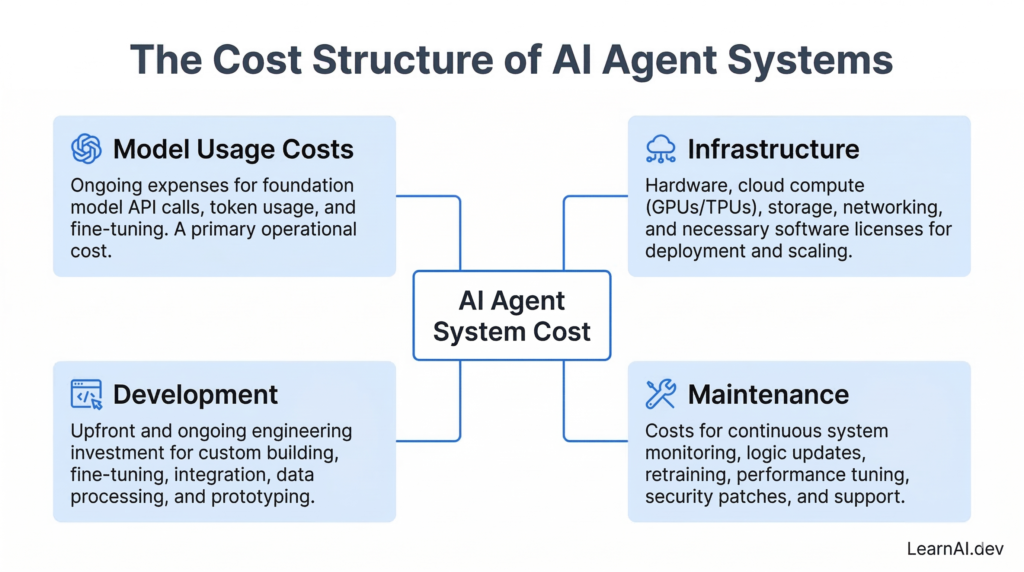
To accurately calculate ROI, organizations must also account for system costs.
AI agents require infrastructure, development, and maintenance.
Typical cost components include:
Model usage costs, such as LLM API calls
Infrastructure and hosting expenses
Development and integration time
Ongoing monitoring and system maintenance
These costs vary depending on the system’s complexity.
A simple internal workflow automation may require minimal infrastructure. A complex multi-agent system integrated across multiple services may require more investment.
Consider a simple research automation scenario.
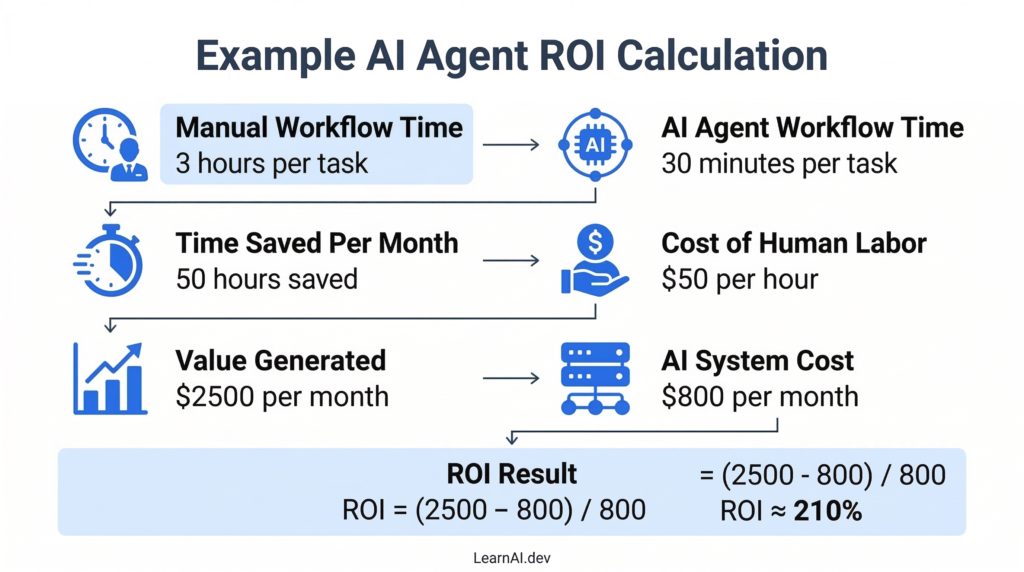
A business analyst spends three hours per day collecting market intelligence and preparing summary reports.
Monthly effort equals roughly sixty hours.
If an AI agent system reduces this work to thirty minutes per day, the monthly effort drops to ten hours.
The time saved each month equals 50 hours.
If the analyst’s effective cost is $50 per hour, the organization saves $2,500 per month.
If the AI system costs $800 per month to operate, the ROI can be calculated.
The value generated equals 2,500 dollars.
System cost equals eight hundred dollars.
ROI = (2500 − 800) / 800
This results in an ROI of approximately 2.1, or 210%.
While simplified, this example illustrates how structured measurement can reveal the business value of AI automation.
Not every workflow benefits from automation.
In some situations, AI agents may introduce more complexity than value.
Common pitfalls include:
Low-volume tasks where automation savings are minimal
Workflows with poorly defined processes
Data environments with inconsistent or unreliable inputs
Processes that require human judgment or creative reasoning
A reliable ROI framework requires an honest evaluation of the underlying workflow.
Automation works best when processes are already structured.
In many cases, ROI increases when multiple agents collaborate within a system.
A planner agent can break complex goals into tasks.
A research agent gathers relevant data.
An execution agent performs actions or generates outputs.
A reviewer agent validates results.
This layered architecture improves reliability and reduces the risk of incorrect outputs.
By distributing responsibilities across specialized agents, organizations create automation systems that are both scalable and trustworthy.
AI agents represent a shift in how work is performed.
Instead of using AI only for assistance, organizations can deploy autonomous systems that manage structured workflows.
However, successful adoption requires more than technology.
It requires clear measurement.
An AI Agent ROI framework helps organizations connect automation to tangible business outcomes.
By evaluating time savings, error reduction, revenue impact, and scalability, companies can move beyond experimentation and begin deploying AI as a strategic asset.
In the long run, the value of AI will not be defined solely by model capabilities.
It will be defined by the processes these systems improve and the outcomes they help organizations achieve.
Subscribe to get the latest posts sent to your email.